


In Gisozi, young teenagers from 20 schools are being trained in science, technology, engineering and mathematics.
These future heirs of the country of Rwanda are grouped around several tables. They are proud to show small machines and explain how they work. These are cranes. They can move, pick up an object with their arm, lift it, move it and put it down in a specific place by remote control. They are in fact mini robots.
These learners from science and TVET (Technical Vocation Education and Training) schools took some three hours to assemble the robots. They were given the necessary materials and clear instructions on the task.

This is not new. The Rwanda National Commission for UNESCO (RNCU) organizes such training events almost every year.
“For science and technology, we target young girls in particular. We want to encourage them to love science and technology,” says Albert Mutesa, Secretary General at Rwanda National Commission for UNESCO (CNRU).
The present boot camp organized from 1 to 4 March 2022 for “Re-imagining and re-thinking Science, Technology, Engineering and Mathematics (STEM) Education” has the particularity of bringing together students and some of their teachers.
“This training workshop aims to give children and teachers the skills to master new technologies and sciences,” says Mutesa.
Skills-based training

For the Secretary of State, Gaspard Twagirayezu, in charge of primary and secondary education, the children must start thinking about the possibility of finding answers to the daily difficulties of life.
“This training camp aims to enable children to see the importance of science and technology lessons in everyday life,” he said.
The politician takes his time to visit the working groups. He talks to the children to check their level of understanding. His visit also allows him to see the ability to use the knowledge acquired to find solutions to everyday problems.
Issa Ngimbanyi from GS St Famille says he has a project to build a mini robot. It will be equipped with a camera. If he is missing an object at home, he will entrust his robot with the task of looking for it. The robot will then send him images on his mobile phone as it circulates around the house. This young man, who is in the third year of the o Level, says he will be able to realize his dream as soon as the necessary equipment is available.
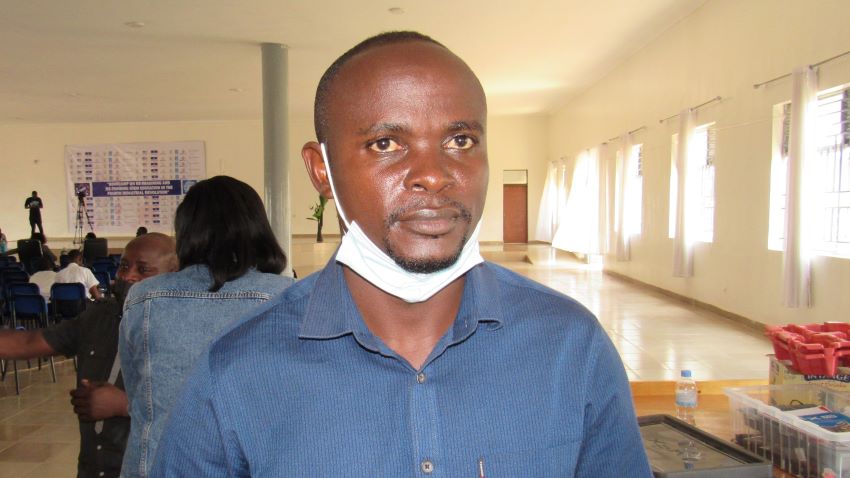
Turning to the teachers, Gaspard Twagirayezu, Secretary of State in charge of primary and secondary education, recommends creativity.
“We ask teachers to continue to help children with the means at hand,” he said. “For the teaching of science and technology, there are materials required. But when the means are not enough, the teacher has to be creative to make the children understand the lesson,” he points out.
According to David Benimana, a chemistry teacher at Collège Saint André, it is possible to teach his class perfectly without the traditional materials. “We know that not all needs can be met. In such a case, we take initiatives to make the children understand the practical lesson given. For example, one can exploit materials found in the learning environment,” he suggests.

Since 2015, the Rwandan education system has opted for a competency-based curriculum. Such a training workshop fits well with this new curriculum. The aim is to put people on the job market who can provide solutions to society.
Gérard Rugambwa


