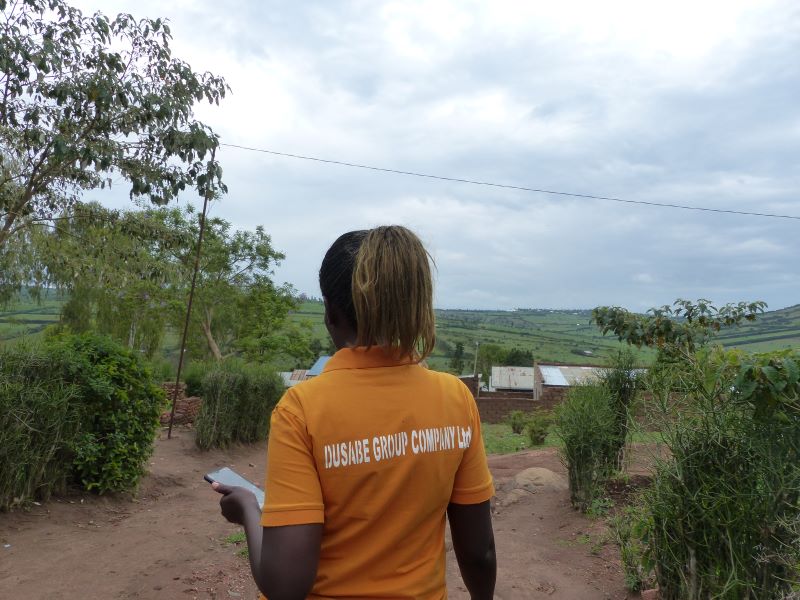
Dusabe groupe company, of Noeline Dusabe, domiciled in Nyagatare, will now have to collect not less than 12 million Rwandan francs each month from the sale of okra and chilli.
The young woman, owner of Dusabe groupe company in Nyagatare, has just signed a contract for the sale of okra with two clients in Europe. The first is in Germany and the second in Belgium. It has committed to supplying them with this sought-after vegetable for a decade.
“Okra is a new crop for my farming business,” says Noeline Dusabe. “I expect the first harvest this November,” she says. “I expect to produce 3 tonnes per week. They will bring in 1.5 million Rwf each time. That’s 6 million frws per month. And that’s for four months in a row, that’s 24 million francs,” she says, beaming with joy.
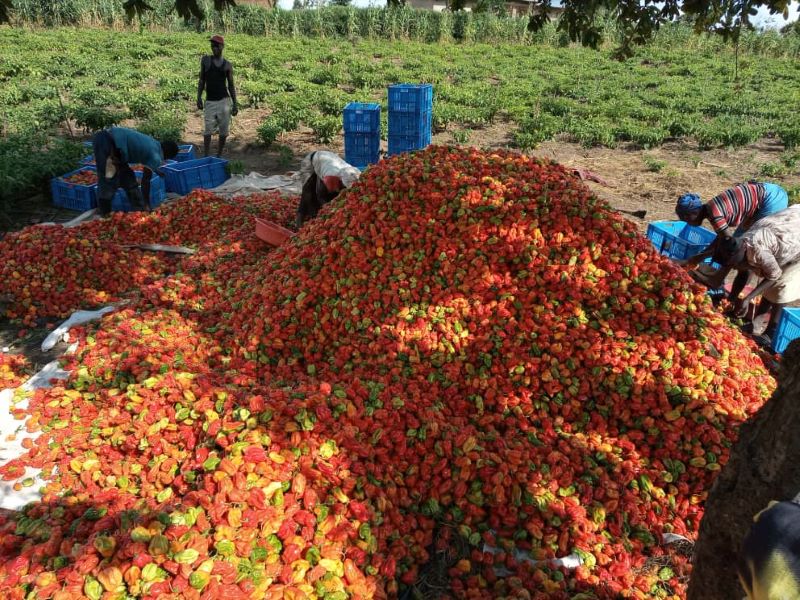
This is in addition to the chilli pepper grown in Kagitumba, in the north-east of the country. Her Rwandan client collects all three tonnes harvested for export through NAEB. “Every month, the income is 6 million. After deducting expenses, I have two million frws left,” she reveals bluntly.
In addition to chilli and okra, she has also started growing ginger. “This is a very new crop for us. It occupies two hectares. We have to wait six months for the harvest,” she says. Unlike the two crops mentioned above, ginger will be marketed in the country.
A large workforce
The 29-year-old, a member of the Rwanda Youth Agribusiness Forum (RYAF), cultivates on six hectares in three different locations. In Nyagatare, Rukomo and Kagitumba.
In all, it employs six thousand people, including 12 contract workers. The others are day labourers. “They are mostly day labourers because at the end of the day they get paid,” she explains.

They don’t all work at the same time. Some are hired during soil preparation and sowing time. Others come for weeding. And finally, Enterprise Dusabe is still looking for workers at harvest time.
Despite the large workforce, the owner confirms that she is doing beneficial work. “Don’t worry, we have a comfortable profit margin, otherwise we would have changed business,” says Noeline Dusabe.
Heavy losses due to the covid-19 pandemic
During the health crisis, commitments were not honoured. Planes were grounded. The sale of chilli was suspended. The chilli deteriorated because it was not harvested in time. And it could not be preserved.
“Chilli doesn’t keep for long,” she says. “I have to do everything I can to engage in the processing of this agricultural product,” she promises. “It will be processed into a powder to produce ketchup chilli. This will enable me to keep it for a long time to sell it at the right time,” she reveals her business strategy.
Following its loss to the covid-19 pandemic, Dusabe Company has reduced its cultivable area. It went from 10 hectares to 6. The workforce was 1200 people. Today, it has been reduced by 50%.
However, she admits that she started with sweet potatoes. She started the business with 100,000 frws. The land she started with belonged to her mother.

After 4 years in the food industry, she can now boast of having an investment capital of about 60 million Rwandan francs. “With my current situation, no one can convince me to change jobs,” she says.
Gérard Rugambwa