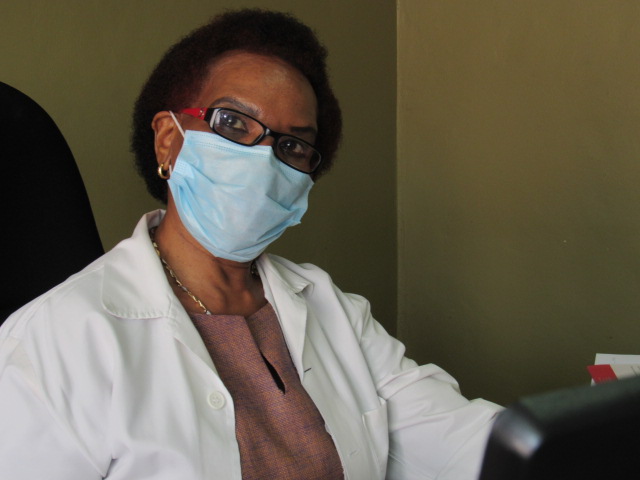
Psoriasis is an incurable but non-contagious disease that attacks the skin. You can live with it for the rest of your life. Sometimes it can lead to complications that make life unbearable. Dr Françoise Gahongayire, from the King Faisal Hospital, gives the details…
Le Canapé: How do you recognize when someone has psoriasis?
Dr Gahongayire: The diagnosis of psoriasis is easy for someone who knows the disease. That is, the signs of psoriasis are very characteristic. They are lesions, …cells that are superimposed especially on prominent places. Some people have them on their elbows, knees, hips or on their hands, shoulders, … but often the patients ignore themselves. Most of the time we see patients who have been around with the disease. So you can find these lesions elsewhere, whether it’s on the abdomen, or on the arms, … it can even be generalized, i.e. the lesions can be located all over the body, from the head to the feet. The signs of psoriasis are dead, white cells that are clustered on the body and fall off.
The diagnosis of psoriasis is clinical. It doesn’t require a big lab for a dermatologist who knows the disease.
Le Canapé: What can cause psoriasis?
Dr Gahongayire: It’s a genetic disease. Some people get it, in some families and in all races. But there is always a trigger. It could be stress, a lot of work, the death of someone you care about, or other serious situations that someone may experience. This can be the basis for triggering the illness. However, it doesn’t happen to everyone. There is this genetic tendency because it is not a microbe that causes it, it is the character.
It’s dead cells that get clumped together because cell regeneration on the skin is a continuous phenomenon. We live with it, which means we have to wash regularly to remove this excess of dead cells.
But psoriasis occurs because there has been a failure to regulate these cells. And even if you wash regularly, they continue to be stored as dead cells. Even if you scratch, the psoriasis can’t go away. It’s a defect in cell regeneration in the skin. This is called keratinization, which is the formation of skin cells. As we live like machines, these cells do not manage to empty themselves completely. They remain and are stored.

Le Canapé: How can this disease be treated?
Dr Gahongayire: It is treated by giving medicines that help to strip, that is to say remove these cells. Basically we also have vitamin A which has an inhibitory effect, it reduces the rate of proliferation of these cells.
Le Canapé: It’s an incurable disease.
Dr Gahongayire: You live with it. I talked about the character of the individual, I talked about the genetics. We don’t live in a healthy world. We are under stress all the time. It’s not an illness that will put you to bed, but it’s perfectly normal to have attacks on a regular basis.
Le Canapé: How do you deal with this almost permanent situation?
Dr Gahongayire: You manage it, because knowing yourself, you can base yourself on the doctor’s explanations and say this is what triggers my illness, and you live with it. We try to pay attention to these everyday stresses and then we live with them. And it becomes stable. I have patients who come after eight months or after a year, for example. Especially when the disease attacks you young and you have been to the doctor in time… the first lesions we know how to manage and it disappears completely and the patient comes back for a consultation when something appears. That’s all. I had a patient, she’s no longer with us, who had psoriasis on her elbows, but she didn’t go to the doctor anymore. She used a lot of oil to moisturize and the lesions did not spread. She would wait and then the crisis would pass. Today there are psoriatic associations that monitor their disease.
But it can also become complicated in some individuals, it becomes generalized, the whole body is affected. At that point, there are medicines reserved for these cases but they are expensive. We block these cells which are at the root of cell proliferation. Here in Rwanda, there are none.
Le Canapé: Advice perhaps.
Dr Gahongayire: Psoriasis patients have to accept their disease, to live with it, to respect the doctor’s advice, it’s very important, … when there is an attack, you go to the doctor, we try to reduce it. You should always try to avoid the complications of psoriasis. That is, when the lesions become numerous on the body and when it can lead to infections. You can have lesions containing pus and sometimes you get arthritic psoriasis. At this point you have pain in the joints. If you take your medication regularly, you can avoid complications.
Interview by
Gérard Rugambwa