


The construction of radical terraces in the Rusenge sector, Nyaruguru district, gives the local population hope for improved living conditions.
The development of the radical terraces in the Cyuna cell in the Cyuna site is a source of hope for better living conditions.
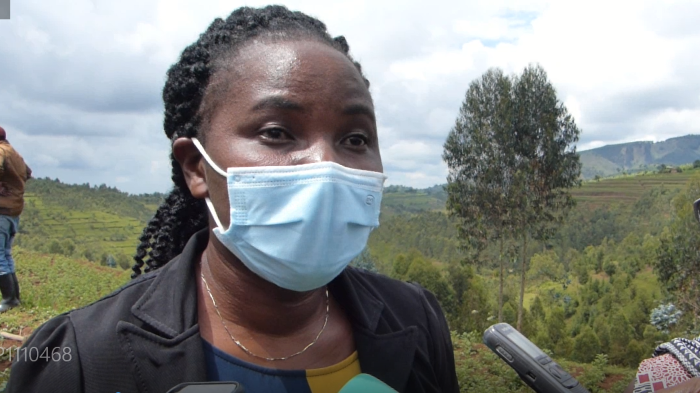
“The landowners were recruited first to build the terraces. They are paid for the work done in their fields. They have been able to afford health insurance, Mutuelle,” says Claudette Muhimpundu, a lady from Cyuna, showing that the terraces have allowed them to earn income before farming begins.
The executive secretary of the Rusenge sector, Spéciose Muhimpundu, does not hide her satisfaction. “The beneficiary population is 772, and they are the most vulnerable. When they are paid, they pay for health insurance, mutual insurance; they buy school materials for their children, they can have their cattle treated,” she shares her joy for this change.’
Nyaruguru, this district of the Southern Province, is a high-altitude region with sometimes steep slopes. For a long time, agricultural production has been insufficient due to erosion.
“On the terraces, rainwater infiltrates the soil and the manure remains there. It is not washed away with the cultivable land every time the rain falls,” says Evariste Mporanyisenga.
According to the Executive Secretary of the Rusenge sector, Spéciose Muhimpundu, potato cultivation has been introduced on the already developed Cyuna site. “27 hectares out of 37.5 hectares of radical terraces have been completed and the activity is ongoing with 722 workers,” she insists.

Another site, Kavumu, in the Rusenge cell, is covered with potatoes on 75 hectares. So far, the population is being supported by partners in Nyaruguru. “In the Cyuna cell, Koïca has provided funding for this project through the World Food Programme (WFP), while the implementation has been entrusted to Good Neighbors. The seeds, natural fertiliser, chemical fertiliser, fodder plants, trees that can be combined with food crops, were all donated by our partner. The beneficiary did not pay for anything,” reveals the executive secretary of the Rusenge sector, Spéciose Muhimpundu.
Purkerie Mukaruhimbi of Cyuna cell, Cyuna village found in her field while disinfecting her potatoes confirms the previous statement. “Good Neighbors helped us to dig gullies, the fodder plants have set, they gave us the seeds, seedlings that are combined with food crops like calliandra, we are waiting for training to become professional farmers,” she says. “Everything is free so far,” she adds gratefully.
Good production expected at harvest time
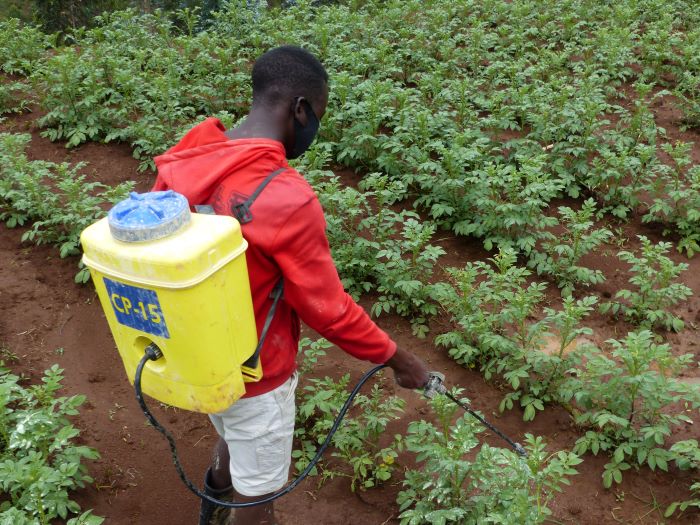
Purkerie Mukaruhimbi expects good production. “The crop maintenance is done at the right time like disinfection, weeding, … I hope the production will be very good,” says Mukaruhimbi.
“Now the production will be good compared to the previous situation,” says executive secretary Spéciose Muhimpundu, apparently confident of this statement.
“After the harvest, the farmers will find food and the surplus will be sold at the market,” says Spéciose Muhimpundu.
According to Nyaruguru district mayor Janvier Gashema, potato production has reached 26.7 tonnes per hectare, sometimes even 30 tonnes per hectare, thanks to the development of swamps and radical terraces, the use of fertilisers and selected seeds.

Potatoes are also grown at Karunga, Uwampura, Akaruvusha, Karigazo, and Agatobwe swamp sites. The Kiramutse site in Cyuna cell, Rusenge sector, is being prepared for the next growing season.
It is hoped that this will continue to popularize potato cultivation in an area where sweet potatoes used to predominate.
Gérard Rugambwa


