The National Commission for Unesco in Rwanda (NCUR) has just introduced a disaster management application to officers for all districts. From now on, information will be transmitted in record time and intervention will be more efficient.
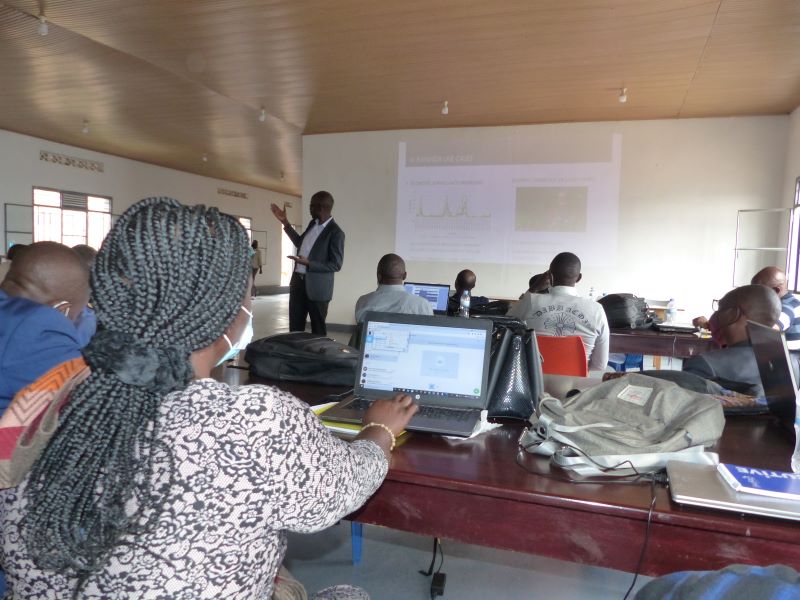
For four days, from 16 to 19 August, disaster management officials in all districts of the country were trained on the use of an application, “line”. The application, installed on their mobile phones, will help reduce risks.
“The beneficiaries were given the opportunity to reflect on how to use this technology to exchange information and therefore make timely decisions on the nature of the response,” said Dominique Mvunabandi, Head of Science and Technology at the National Commission for UNESCO in Rwanda (CNUR).
Disaster management officials in the country’s districts recognize the usefulness of this new feature in their work. “This application will allow us to give or receive information quickly, all the concerned authorities will be able to receive the information at the same time,” says Adrien Nizeyimana, head of disaster management in Rutsiro district.
“The traditional reporting system limited us to certain people in the transmission of information,” he criticizes. “The person who had to intervene could be unaware of ongoing events,” he points out the drawback.
For François Hakizimana, in charge of disaster management in Gisagara district, this application will help keep information. “Before, we used short messages (SMS) on mobile phones. It was very easy to disappear if your phone was stolen, for example,” he says.
A multi-functional application

According to Gretta Muhimpundu, one of the trainers, the application is used at all stages of a disaster, from prevention to response. It has several menus.
One is the reporting disaster. The content always indicates the location. “When using this disaster reduction application, you are required to activate the location. Then the program asks you what the problem is,” says trainer Muhimpundu, citing some of the steps to be taken. “You can take a photo or write a text and send it. The manager immediately sees the location of the disaster and reacts to your message,” she explains.
The other menu is about emergency response. “If there is a disaster and you want to know where the disaster site is, as soon as the ministry in charge of emergency management is informed, it tells you the location,” says Muhimpundu. …
The application will be operational throughout East Africa. In the sub-region, climatic and geological hazards have taken on unexpected proportions.
Floods in Kenya and Rwanda, drought in the Horn of Africa, earthquakes in North West Tanzania and recently in North Kivu, DRC, as well as in North West Rwanda (Rubavu) with the Nyiragongo volcanic eruption, are some recent events.
Artificial Intelligence (AI) in disaster reduction has been introduced in Rwanda in partnership with several stakeholders. They are the UNESCO Regional Commission for East Africa, the Ministry of Environment (MOE), the Ministry of Emergency Management (MINEMA) and the University of Tokyo.
Such training will be extended to several categories of people. And anyone will be able to use this application on risk reduction in disaster management. All you need to do is to know how to use it and download it to your mobile phone.
Gérard Rugambwa