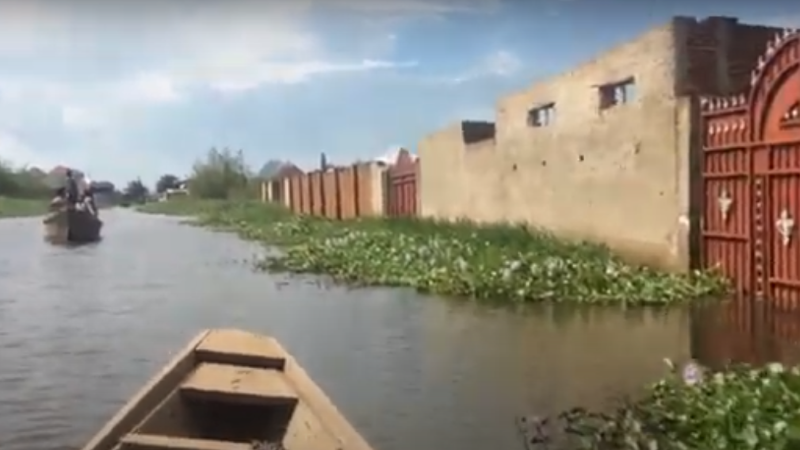
The rising waters of Lake Tanganyika have led to an overflow that is causing significant material damage and an evacuation of the affected population.
According to several corroborating sources, the waters of Lake Tanganyika have been rising continuously since last year in 2020. From an average level of 772.7m, they reached 776.45m in April 2021. This is an increase of more than 4m which led to an overflow.
They overflowed and invaded the beaches in Bujumbura. The lake rejected the solid waste as if it was revolting against its pollution. Hippos and crocodiles are threatened in their natural habitat. The macadamized road along the lake is not spared. The population of Gatumba is affected because the houses are bathed in water. The rivers Mpanda, Grande and Petite Rusizi flowing into the lake have had to make their way to Gatumba, unable to continue their trajectory due to the rising waters of the lake.
Some of the inhabitants of the Gatumba area, bordering the DRC (Uvira), were evacuated. The tourist business on the lake is somewhat disrupted.
It would only take a rise of 0.55m for the port of Bujumbura to be flooded. This would paralyze port activities.
This phenomenon would be simply natural because it is not new. In 1878 the lake reached a height of 783.60m; in 1964, 86 years later, the level of the lake rose to 777.08m; the lake is still being talked about in 2020-2021.

Others do not rule out the effects of global warming.
This situation is also partly due to non-compliance with the 2012 water code. The latter provides for a 150 m wide strip of water from the lake that is part of the public domain. It is now clear that this code has been violated. And the waters of the lake have overflowed in some places to more than 500 m.
The Council of Ministers takes up the case
The Council of Ministers held on 5 May in Gitega, the political capital of Burundi, discussed the management plan for the Lake Tanganyika coastline.
The executive judged that this document deserves to be further developed with the support of experts from different fields before its adoption. There is also a need for a sanitation study of the rivers that flow into Lake Tanganyika to protect it from pollution and to protect the people living along these rivers.
The Ministry in charge of infrastructures should draw the consequences of the current behaviour of Lake Tanganyika. The infrastructures under study or in the making should be aligned with standards that take into account the current situation.
Furthermore, the council of ministers requested that the victims be supported by the ministries concerned.
Gérard Rugambwa