


The historically marginalized people (HMP) of Musanze want the school feeding program to continue as it has enabled their children to access secondary school. Both the public institutions and the population appreciate the performance of the Rwandan Red Cross (RRC) acting as an auxiliary to the state in improving the socio-economic conditions of vulnerable people.
The Rwandan Red Cross (RRC) has initiated a school feeding program, “School feeding”, for the primary school children of historically marginalized people. This project has benefited this vulnerable category of the population.
“With this project, we have seen several of our children go to secondary school for the first time,” says Jean Pierre Mupenzi, from the Musanze district, Shingiro sector, Mugari cell, Terimbere village. “Two are in a secondary school with boarding school, two others will soon finish technical education, and one has started university,” he says. “With this program, the RRC paid for the midday meal for our children. This program ended too early,” he regrets. “We miss school feeding,” he said.
Jimmy Léonard Kubwimana, a RRC volunteer in Musanze, reveals that the school feeding program ended in March 2020 with the start of the covid-19 pandemic. “Schools in the affected areas of the Volcanoes National Park, such as Musanze, Kinigi, Shingiro and Nyange have all benefited from this school feeding program,” says Kubwimana. “It was aimed at children from historically marginalized families attending primary school,” he says. It was an innovative project because the other initiatives targeted secondary school children.
The HMP project has several components
According to the RRC’s annual report (2019-2020), the school feeding program is a component of the major HMP (Historically Marginalized People) project.
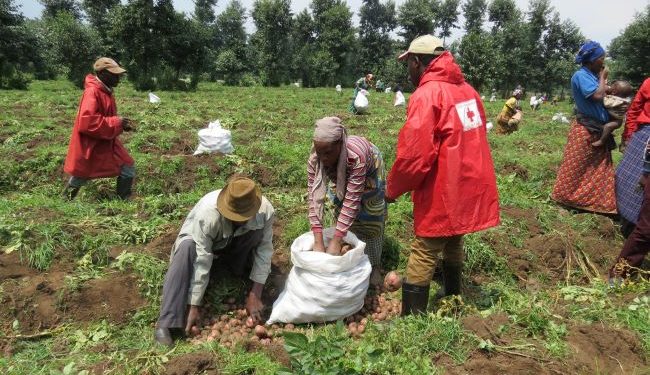
Other components include the creation of farmer’s cooperatives. “The RRC bought us arable land, seeds and fertilizer were distributed to members and we benefited from training,” says Jean Pierre Mupenzi of the Shingiro sector in Musanze district.
“By the end of the project in Musanze, these cooperatives had already acquired legal status with the support of the RRC,” adds Jimmy Léonard Kubwimana.
With the active participation of RRC volunteers, pilot kitchen gardens were used to demonstrate and popularize installation techniques in each village. Subsequently, households adopted the approach in their respective homes.

In addition, these historically marginalized people also appreciate the hygiene and sanitation component. “Hygiene and sanitation has made us cleaner. People in our category were characterized by a lack of hygiene. Today, there is a remarkable change,” says Jean Pierre Mupenzi.
Some of these vulnerable people have benefited from the houses. Others have received sheets as part of a collaboration with the administration, which has undertaken a similar project. Livestock was offered to this category of the population with their participation. This was achieved through the construction of enclosures. The promotion of voluntary savings and loans has been very useful. It has encouraged the payment of mutual health insurance cards in some districts, for example.

In addition to the Musanze, Burera and Gicumbi district supported by the Danish Red Cross (RC), the HMP project was carried out in several other districts such as Karongi, Rutsiro, Ngororero, Nyabihu, Gakenke with the financial support of the Belgian Red Cross (CR) of the French-speaking community. HMP Nyamasheke was supported by the Austrian RC; HMP Gisagara by the Japanese RC participating National Societies and Bugesera supported by the Spanish RC, shows this 64 pages’ annual report produced by the RRC.
The Secretary General of the RRC, Apollinaire Karamaga, expresses his gratitude to the public institutions, volunteers and beneficiaries for their spirit of cooperation. This is at the origin of the success of this organization in its initiatives.
Gérard Rugambwa


