


The living conditions of the expelled population from Tanzania and the vulnerable in the host community are changing dramatically thanks to the support of the Rwandan Red Cross (RRC) in collaboration with local authorities.
A population of 300 people in the two sectors of Rwimiyaga and Karangazi, Nyagatare district, are undergoing social and economic transformation thanks to RRC support.
“When we arrived in Rwanda, expelled from Tanzania, we didn’t know how to farm, we were coming out of the forest where living,” says Diane Umurerwa. “The RRC taught us farming techniques,” she says. “We know the seasons, we know the right time to grow maize, the right time to grow beans. We had never heard of this before,” she reveals.
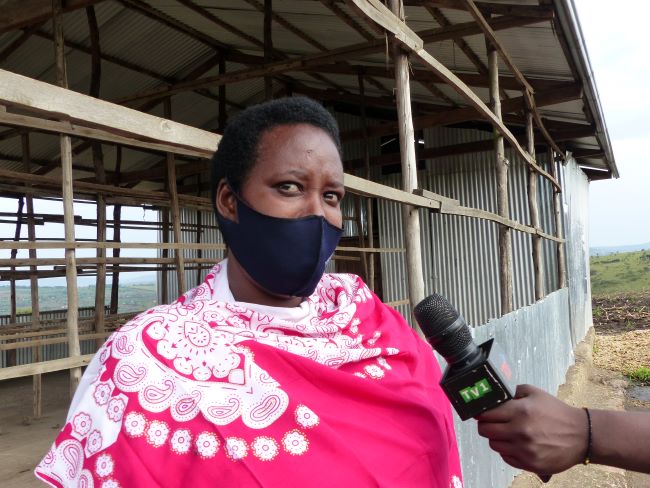
Today, this population, which has taken its destiny into its own hands, alternates crops on an area of 60 hectares purchased by this humanitarian organization, which is an auxiliary of the state. “At harvest time, each member of the cooperative receives his or her share and gives food to his or her children, who eat their fill,” she says. “The rest is sold on the market, with businessmen coming to buy our crops at a good price,” she boasts.
“We have opened a bank account where we put our earnings for savings. None of us can afford not to have health insurance,” she says. “Now we have been able to afford electricity connections. Our houses are lit with electricity; the state has provided us with the necessary energy infrastructure. A member of the cooperative can apply for a 100,000 loan for the electricity connection. The interest rate is very low to allow all our members who want to benefit from this source of energy,” she explains how social and economic transformation has become a reality.

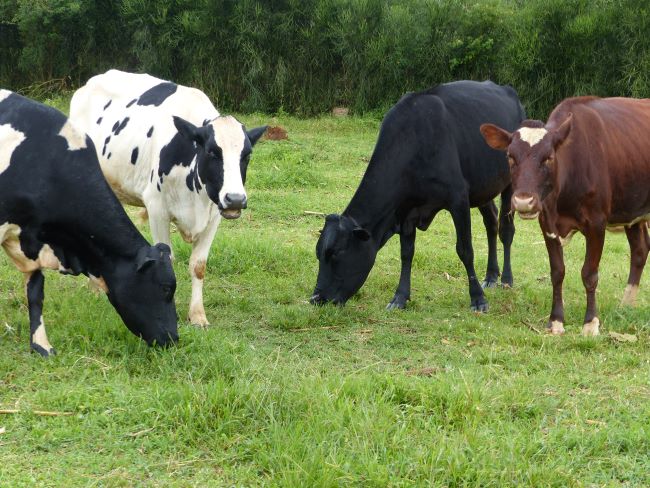
“This resilience project allows us to pay school fees for our children and meet other needs such as clothing. The Red Cross is our father, it’s our mother…” said Byabagambi Hassan, whom we met while he was tending his cows donated by the RRC.
The participation of all parties, a guarantee of success…
For a good supervision, this population has been divided into several groups. “In our group, we are 22. The RRC offered us 5 cows, 2 died. These cows have reproduced. 13 of us are already breeders in a rotational distribution system until everyone is served. In the next season, the rest will each receive a heifer,” he says. “Our children did not suffer from Kwashiorkor,” Byabagambi adds, very happy because they were more like farmers before they were forced to return home.

In her speech on livestock, Diane Umurerwa starts by speaking normally but towards the end she raises her voice. “The first time the RRC gave us goats, the second time they gave us goats and for the third time they brought us cows. Our children drink milk! We are satisfied… I don’t know how to express this well,” she says, no longer able to hide her emotion. “We produce a lot of milk. We consume it in our families and the rest is sold to the milk collection centers,” she explains.
Continuing with nutrition, Diane Umurerwa, a seemingly healthy mother, does not forget the vegetable gardens she enjoys. “They taught us how to maintain vegetable gardens, we lived in the forest in Tanzania, it was something new for us, we started to eat vegetables, it was also new for us, kinds of vegetables we had never seen, like carrot, beetroot, … a lot of vegetables,” she tries to express how she feels.
These Rwandans from Tanzania are not ready to forget the welcome they received when they arrived in Rwanda and the houses built by the state for them.

According to the Director of Communication and Humanitarian Diplomacy, Emmanuel Mazimpaka, this project was set up with the participation of all parties concerned. “Before the launch of this project, the population was consulted and the local government intervened to show the most vulnerable category that should benefit,” he reveals the participatory method adopted. “So the project being implemented is aimed at improving the living conditions of the beneficiaries,” he shows the purpose of this intervention. “At the end of the project, we will hand it over to the grassroots authorities who will have to ensure its sustainability before committing ourselves elsewhere in the country,” he concludes.
Gérard Rugambwa





We as staff of red cross we strongly proud of what we did to them ( Rwandans returnees from Tanzania)
We appreciate the contribution of Red Cross volunteers in strengthening the resilience of vulnerable communities